

Day of the Dead in Mexico City: Four Days Following Frida and Diego
Day of the Dead in Mexico City is officially observed on 1 and 2 November, but the public altars, the exhibitions and the flower markets begin days earlier. This guide covers four days, from Saturday 31 October to Tuesday 3 November 2026. Six of the Day of the Dead altars worth planning around are at the Museo Dolores Olmedo, San Fernando, the Museo de Arte Popular, the Zócalo, Casa Azul and Anahuacalli, and this guide visits all six. Two cemeteries are open to visitors over the holiday: the Panteón Civil de Dolores, where Rivera is buried, and the Museo Panteón de San Fernando, the most evocative historic cemetery for understanding the Mexican politics of the nineteenth century.
Underneath the four days runs a single thread: a reunion that never took place. Diego Rivera left instructions that his ashes be mixed with Frida Kahlo's and kept at Casa Azul, the house in Coyoacán where their life together had unfolded. It did not happen. Frida's urn sits in her bedroom. Diego lies in the Rotonda de las Personas Ilustres at the Panteón Civil de Dolores, on the other side of the city. And the woman entrusted with both their legacies, Dolores Olmedo, is at her hacienda in Xochimilco, surrounded by the collection she spent forty years assembling. Three houses, three sets of remains, and a wish nobody carried out.
When is Day of the Dead in Mexico City in 2026?
Officially Sunday 1 and Monday 2 November 2026. Public altars, exhibitions and flower markets begin in mid-October.
How many days do you need?
Four. This itinerary runs from Saturday 31 October to Tuesday 3 November 2026.
Are museums open on 2 November?
Most are closed, including Casa Azul, Anahuacalli and the Museo Dolores Olmedo. Spend that day at the Panteón Civil de Dolores instead. Follow the order below to work around the museums' regular Monday closures.
Do you need tickets for Casa Azul?
Yes. Casa Azul sells timed tickets and they should be booked weeks ahead.
When is the Day of the Dead parade in 2026?
Saturday 31 October 2026, from 2 pm along Paseo de la Reforma. This itinerary does not depend on it.
In this guide · Saturday 31 October · Sunday 1 November · Monday 2 November · Tuesday 3 November
Saturday 31 October 2026: Mercado de Jamaica and the Museo Dolores Olmedo
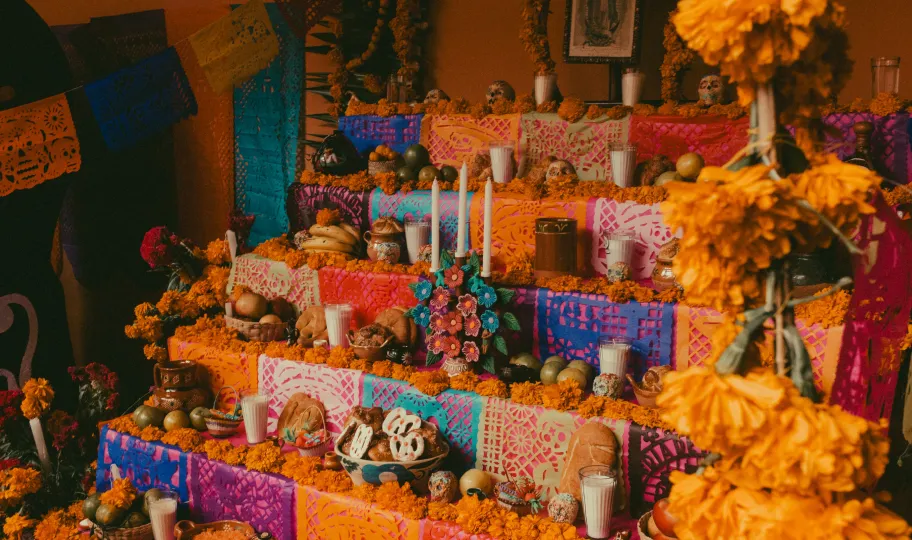
Start at the Mercado de Jamaica, the city's flower market, before the heat sets in. From mid-October a romería runs along its perimeter, an outdoor market where the smell of orange blossom and sugar drifts down the aisles. At the sidewalk bakery a long table is laid out with dozens of eggs, kilos of flour and a sprinkling of yeast, and pan de muerto comes out of the ovens every hour. Take one warm and keep walking.
At dawn the trucks come in from Puebla, Xochimilco and Michoacán. By mid-morning the market overflows with burnt orange marigolds, magenta cockscomb and the pale flor de nube that appears on almost every altar in the city. Marigolds are there because their scent is believed to draw the dead back. Buy an armful. If they become unmanageable, our house on Colima Street is twenty minutes north and the front desk will hold them until the evening.
Then head south to La Noria. In 1955, two years before he died, Rivera appointed Dolores Olmedo head of his trust and encouraged her to broaden the collection she had already begun, adding Kahlo's work, other Mexican painters and pre-Hispanic artefacts. Olmedo bought the sixteenth-century Hacienda La Noria in 1962 and filled it with all of it, along with roving peacocks, wild turkeys and xoloitzcuintli dogs. She opened it as a museum in 1994.
It closed in 2020 and stayed closed for six years, through a long public argument about whether the collection should be moved at all. It reopened on 30 May 2026, making this its first Day of the Dead season since 2019. The altar here has long been the most elaborate of any museum in the city.
For a late lunch, San Ángel Inn is on the way back. The former hacienda has dining rooms wrapped around an open courtyard and formally dressed waiters. The menu runs from Mexican classics to international dishes; order the mole, any of them.
Saturday 31 October: Mercado de Jamaica, Museo Dolores Olmedo, San Ángel Inn.
Sunday 1 November: San Fernando, the Museo de Arte Popular and the Zócalo
The holiday cannot be understood without a day in the Centro Histórico. This is the original city of the Mexica, who had their own relationship with death through sacrifice and the keeping of bones and skulls.
Begin at Café de Tacuba, inside a seventeenth-century casona on Tacuba Street. The building was once part of the Santa Clara convent, then a dairy and shop known for its bread, milk and atoles. Order the enchiladas tacubas, some pastries and a café de olla, and take your time. This is the day's one full meal.
Then walk west to the Museo Panteón de San Fernando, open Tuesday to Sunday, and ask for the guided tour; in recent years it has run around midday. Benito Juárez is buried here, among the tombs of Vicente Guerrero, Ignacio Comonfort, Miguel Miramón and Margarita Maza. The cemetery opened in 1832 and closed with Juárez's burial in 1872, forty years and no more, which is why the tombs feel like a single generation talking among themselves. Entry is free, the museum mounts its own ofrenda for the holiday, and the tour is the reason to come. Without it the names on the crumbling stones stay names.
Five minutes away, the Museo de Arte Popular holds regional craftwork from every state. Its altar goes up in the central patio and is built to show what Mexican artisans can do. Giant alebrijes are usually at the centre of it. The form was invented by Pedro Linares in 1936, after he fell ill and dreamt of wild, imaginary creatures.
Finish at the Zócalo as the light goes. Day of the Dead is a family holiday, but in a city this size there are dozens of public altars mounted by the government and by the businesses that keep it running. The ofrenda in the main square changes every year in its elements and its layout. Ceramic skulls several metres high, papier-mâché skeletons and thousands of marigolds cover one of the largest plazas in the world, and they read better at dusk than at noon.
Sunday 1 November: Café de Tacuba, Museo Panteón de San Fernando, Museo de Arte Popular, the Zócalo ofrenda.
Monday 2 November: Panteón Civil de Dolores and the alebrijes on Reforma
The second of November is the day families spend with their adult dead, and it is also the day almost every museum in the city is closed. Spend it in a cemetery, which is where the holiday actually happens.
Fuel up at El Cardenal on Paseo de las Palmas with a classic Mexican breakfast. Order the pan de muerto hot from the oven with nata, and one of their hot chocolates frothed at the table. The Panteón Civil de Dolores is about forty-five minutes on foot from there, or ten by car.
Diego Rivera died of heart failure in his San Ángel house in November 1957. His instructions were clear, but his wife and daughters had their own idea of how to honour him. His remains were taken in a long procession to the Panteón de Dolores and placed in the Rotonda de las Personas Ilustres, a circular plaza at the centre of what is now the largest cemetery in the country. The Rotonda is federal ground rather than part of the cemetery proper, a hundred or so graves arranged around a central column.
On the first and second of November the panteón fills with thousands of families who come to clean and decorate graves and then stay, often all day and into the evening. Music plays, live and tinny from stereos. People eat where they sit.
Visiting requires tact. For many families the day holds real levity, but some losses are more recent than others, and a stranger with a camera is a stranger with a camera. Keep the phone down more than you raise it, walk the aisles the way the local visitors do, and photograph no one you have not spoken to. If that feels like too fine a line, come on the third instead, when the graves are still dressed and the crowds have gone.
Leave by Constituyentes and walk down to Paseo de la Reforma. The monumental alebrijes stand on both pavements between the Ángel de la Independencia and the Estela de Luz, usually from mid-October into the first week of November, a competition among papier-mâché makers to see who can build the most improbable beast.
Monday 2 November: El Cardenal, Panteón Civil de Dolores, the alebrijes on Reforma.
Tuesday 3 November: Casa Azul and Anahuacalli
Casa Azul requires timed tickets, booked weeks ahead. Before you go south, stop at the Rosetta bakery for a pan de muerto and an Americano. Coyoacán is about twenty minutes by car from Colima Street.
Among the objects, paintings and Frida's death mask in her old bedroom sits a pre-Hispanic urn holding her ashes. In the year before she died she told friends that after so many hours spent lying in bed, she could not bear the thought of lying down for eternity, and asked to be cremated. Those who went with Rivera to the crematorium said a blast from the furnace pushed her body upright and set her hair alight, and that she appeared to be smiling. A last piece of theatre from a woman who had thought about death her whole life.
Each year a large altar goes up in the blue-walled garden, among the cactus and bougainvillea: marigolds, photographs of Frida and Diego, small ceramic figures from their own collection, and the fundamentals, which are water, salt, food and papel picado.
Then continue south to Anahuacalli, which Rivera built from the black lava the Xitle volcano poured over this part of the city some seventeen centuries ago. He designed it himself, drawing on pre-Columbian architecture; Juan O'Gorman finished it, and an annexe by Mauricio Rocha was added in 2021. Rivera meant it as a temple for the thousands of pre-Hispanic pieces he had gathered over a lifetime, chosen by instinct rather than scholarship. He died before it was done, and the museum opened in 1964.
Two niches on the main floor were left empty, in the hope that his urn and Frida's would one day sit side by side. They are still empty.
The museum's ofrenda is not decoration. It is an annual exhibition honouring a major figure in Mexican art, and this year it goes to Saturnino Herrán, a precursor of Mexican muralism and an influence on Rivera.
For a late lunch, Los Danzantes sits on Coyoacán's central plaza, a shaded corner from which to consider a neighbourhood that was a small town when two of the country's greatest painters lived in it.
Tuesday 3 November: Panadería Rosetta, Casa Azul, Anahuacalli, Los Danzantes.
Four days is the right length for this holiday and the wrong length for the city, so if you are coming from further afield, our long weekend guide for Californians picks up where this one stops.
We keep sixteen Studios on Colima Street, a five-minute walk from Rosetta and twenty minutes by car from Coyoacán. For stays of four nights or more, any night in October, we build an altar in your Studio. Send us a photograph of someone you want remembered and it will be waiting when you arrive. How it is arranged.
See you in Mexico City.
