

A field guide for Mexico City
How to Spot a Real Taquería
Mexico City has thousands of taquerías. The best ones have operated for decades, sometimes generations, and they hold the city's culinary memory in a way few other institutions do. The worst ones depend on travelers who don't know what to look for — overpriced, underwhelming, often advertised in the languages most spoken by tourists.
Telling them apart is not difficult once you know what to observe. The signs are visible from the street, before you order, before you sit down. What follows is a field guide to recognizing a serious taquería in Mexico City.
The Specialization
The first thing to know is that real taquerías specialize. They do one preparation extremely well, and that preparation is what they are known for. Tacos al pastor, suadero, barbacoa, carnitas, birria — each is its own discipline, with its own cooking technique, its own equipment, its own rhythm of service.
A taquería with a menu that lists pastor, suadero, carnitas, barbacoa, alambres, gringas, quesadillas and seven kinds of meat is almost certainly mediocre at all of them. A taquería that has been making only pastor for thirty years, with one trompo and one taquero, is signaling something about how seriously it takes the form.
The rule — the shorter the menu, the more serious the taquería. The best places often serve only two or three things. The rare ones with a slightly broader menu — like Charco de las Ranas, with its pastor, chicharrón de queso, frijoles de la olla and bistec — are the exception that proves it: every item executed at the same level of seriousness.
The Trompo and the Hour
For tacos al pastor — the marinated pork sliced from a vertical spit — timing is everything. Pastor is cooked on a trompo, a vertical rotisserie that takes hours to develop the deeply caramelized exterior that defines a great pastor taco. A trompo just lit at 2 PM will not produce the same taco as one that has been turning since noon and is being served at 6 PM.
The rule — for pastor, arrive after 5 PM. By that hour the trompo has been cooking for hours, the exterior has reached the right caramelization, and the taquero is slicing at its peak. Late night is even better.
A few of the most respected pastor stands in Mexico City, where this rule applies most clearly:
El Vilsito
Narvarte
A mechanic shop by day, a taquería by night. Opens after 7 PM, when the trompo is fully developed. Among the most respected pastor stands in the city.
El Borrego Viudo
Tacubaya
Open twenty-four hours, but its best pastor is served late — past midnight, when the trompo has been turning all evening.
Tacos Manolo
A loyal local following for both pastor and suadero. The kind of place that does not show up in tourist guides because it does not need to.
Taquería Selene
A serious taquería with a quiet reputation among locals, particularly for its pastor and campechano.
Charco de las Ranas
Río Mixcoac
An impeccable pastor, alongside an exceptional chicharrón de queso, the best frijoles de la olla in the city, and a serious bistec. A short, focused menu executed with discipline.
El Tizoncito
Condesa only
One of the original pioneers of pastor, claiming to have invented the modern version in 1966. The Condesa location remains serious; other branches are franchised and quality varies. If you go, go to Condesa.
The Tortillas
The tortilla is half the taco. A great filling on a mediocre tortilla is a mediocre taco. A perfect filling on a mass-produced refrigerated tortilla is a wasted taco.
The rule — look for the tortillera, the person making tortillas in plain sight. A serious taquería will have someone working a comal and pressing tortillas to order. The masa is fresh, the tortilla is warm, and the structural integrity of the taco is built around it.
If you cannot see anyone making tortillas, they are coming from a bag — refrigerated, possibly frozen, reheated on a flat-top. The flavor is muted, the texture is wrong, and the whole experience is compromised. This single detail eliminates the majority of tourist taquerías before you even order.
The Salsa Table
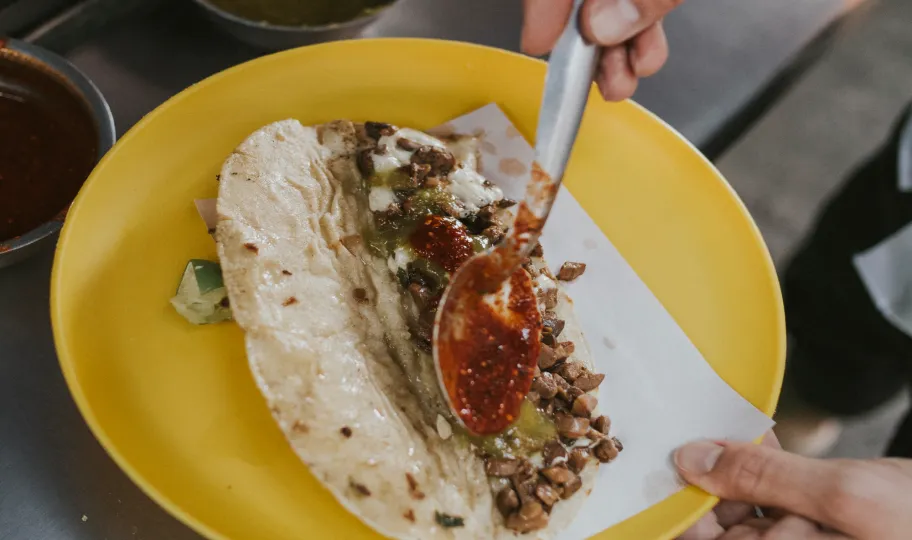
Salsas are not a side. They are part of the taco. A serious taquería offers between three and five salsas, freshly made, replenished throughout the day, with distinct character: a roja, a verde, often a chile de árbol, sometimes a habanero, occasionally a regional specialty like a salsa macha.
The rule — look at the salsa table before you sit down. One or two salsas in commercial bottles, watery in texture? The kitchen is not paying attention. Several salsas in clay bowls or steel containers, freshly ground, with visible texture and color? You are in a serious place.
A small note: in Mexico City, the green salsas are often hotter than the red ones — the opposite of what most travelers expect. Try in small amounts before committing.
The Smell
A serious taquería announces itself before you see it. The smell of pastor caramelizing, of suadero rendering in copper, of fresh tortillas on a hot comal — these reach the sidewalk half a block before the door does.
The rule — if you can smell the taquería before you can read its sign, that is a good sign. If you walk inside and smell nothing distinct — no smoke, no meat, no masa — the kitchen is not cooking with the intensity required to produce a great taco.
Six
The Taquero
The same trompo, in two different hands, produces two different tacos. The taquero — the person slicing the meat and assembling the taco — is the most important variable in the equation. Years of experience, the angle of the knife, the way the meat hits the tortilla, the rhythm of service — all of it is the taquero's craft.
The rule — the best taquerías keep the same taqueros for years, sometimes decades. Watch the rhythm. A taquero working a trompo with practiced economy — slicing with one hand while catching meat on a tortilla with the other — is performing a discipline that takes years to master. One who looks new, distracted, or is being instructed signals a different level.·
A Final Note
The best taquerías in Mexico City rarely have polished websites. Many do not have Instagram. Some have no social media presence at all. They are recommended by word of mouth, by the line at the door, by the taxi driver who picks you up at 11 PM and asks where you are going.
If you want to find them, the most reliable method is also the oldest: ask someone who knows the neighborhood. Ask the person at the front desk of your hotel. Ask the taxi driver. The answer will rarely be a place with five thousand reviews. It will be a place that has been there for forty years, that opens at sundown, that has one taquero and one trompo, and that no one outside the neighborhood has ever bothered to write about.
